

By SHAISTA TASLEEM
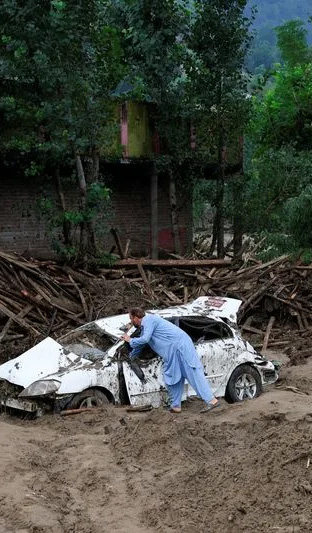
Natural disasters occur across the globe, but their scale and devastation often depend not just on nature itself but on human actions. One such destructive phenomenon is the cloud burst, which in recent years has struck Pakistan repeatedly with deadly consequences. This is not merely a weather event it is a warning. Unless we change our policies and lifestyle, the future may see entire towns and valleys wiped off the map. A cloud burst is a rare meteorological event where massive amounts of moisture in clouds are suddenly released over a small area within a very short time. At first glance, it seems like heavy rainfall, but it is far more dangerous because both the volume and speed of water are exceptionally high. What normally falls as rain over several hours can pour down in just a few minutes, overwhelming rivers, streams, and entire settlements. Experts explain that cloud bursts are often triggered when moisture-laden clouds collide with mountains or when hot and cold air masses meet suddenly. In Pakistan, these events mostly occur in northern mountainous regions such as Khyber Pakhtunkhwa (KP), Gilgit-Baltistan, and Azad Kashmir. But why are they becoming more frequent? The answer lies in climate change and reckless human interference with nature. While natural disasters cannot be completely prevented, their impact can be reduced. Unfortunately, Pakistan has long ignored climate change as a serious national threat. Unchecked deforestation, unregulated construction along riverbanks, mushrooming hotels in fragile mountains, poor drainage systems, and rising global temperatures all have intensified the severity of cloud bursts. During the monsoon season, Pakistan now receives higher-than-usual rainfall due to increased atmospheric moisture. When this moisture accumulates over mountainous regions, it can suddenly release in catastrophic bursts. Climate change has disrupted traditional weather patterns, making extreme and unpredictable events more frequent. The 2025 monsoon season turned deadly for Khyber Pakhtunkhwa. In early August alone, cloud bursts and flash floods wreaked havoc on an unimaginable scale. More then 500 people lost their lives, over 1,000 were injured, and dozens remain missing. Official reports confirm that more than 1,800 houses were completely destroyed, while another 4,000 sustained partial damage. Entire villages in Kohistan, Swat, Upper and Lower Dir, and Mansehra were wiped out. Roads, bridges, and critical infrastructure were torn apart by raging torrents of water. The Karakoram Highway was blocked at several points, cutting off entire valleys from relief supplies. In Gilgit-Baltistan, multiple valleys were left completely isolated as roads and communication networks collapsed. Rescue operations faced massive challenges as washed-out bridges and landslides made access nearly impossible. Farmers bore the heaviest losses. Thousands of acres of standing crops were destroyed, and livestock drowned in the floods. For families in northern KP who rely on subsistence farming, this disaster has pushed them into acute economic distress. The impact of cloud bursts extends far beyond immediate deaths and destruction. Tourism, one of the main sources of livelihood in northern Pakistan, has suffered a severe blow. When roads and hotels are swept away, tourists stay away, leaving thousands of local families without income. Small businesses, already struggling in a fragile economy, collapse under the pressure of repeated disasters. The agricultural sector also faces long-term setbacks. Destroyed crops and drowned livestock not only disrupt food supply chains but also deepen rural poverty. Women and children, who are already vulnerable, are disproportionately affected when families lose shelter, food security, and sources of income. At the national level, the government is forced to spend billions on emergency relief, but sadly these funds rarely translate into long-term resilience planning. The cycle repeats every year—disaster, loss, temporary aid—while root causes remain unaddressed. Cloud bursts cannot be prevented, but their destruction can be minimized with proper planning and foresight. The following urgent steps are essential: • Ban illegal construction in vulnerable mountain zones and along riverbanks. • Strict regulation of urbanization in valleys and floodprone areas. • Declare reforestation a national emergency, reversing decades of unchecked deforestation. • Invest in modern early-warning systems, using technology to forecast and alert communities in advance. • Raise public awareness about disaster preparedness and safe construction practices. Cloud bursts are not new, but their increasing intensity and frequency highlight the reckless way we have treated our environment. The Earth is now forcing us to pay the price. If we continue with business as usual, the human and economic toll will only rise. Natural disasters may not be within our control, but reducing their impact surely is. The choice lies with us: either we accept responsibility and act now, or we resign ourselves to a future where every monsoon brings another cycle of death and destruction. The time to choose wisely is now before the next cloud burst strikes.










Leave a Reply