

Amjad Hadi Yousafzai
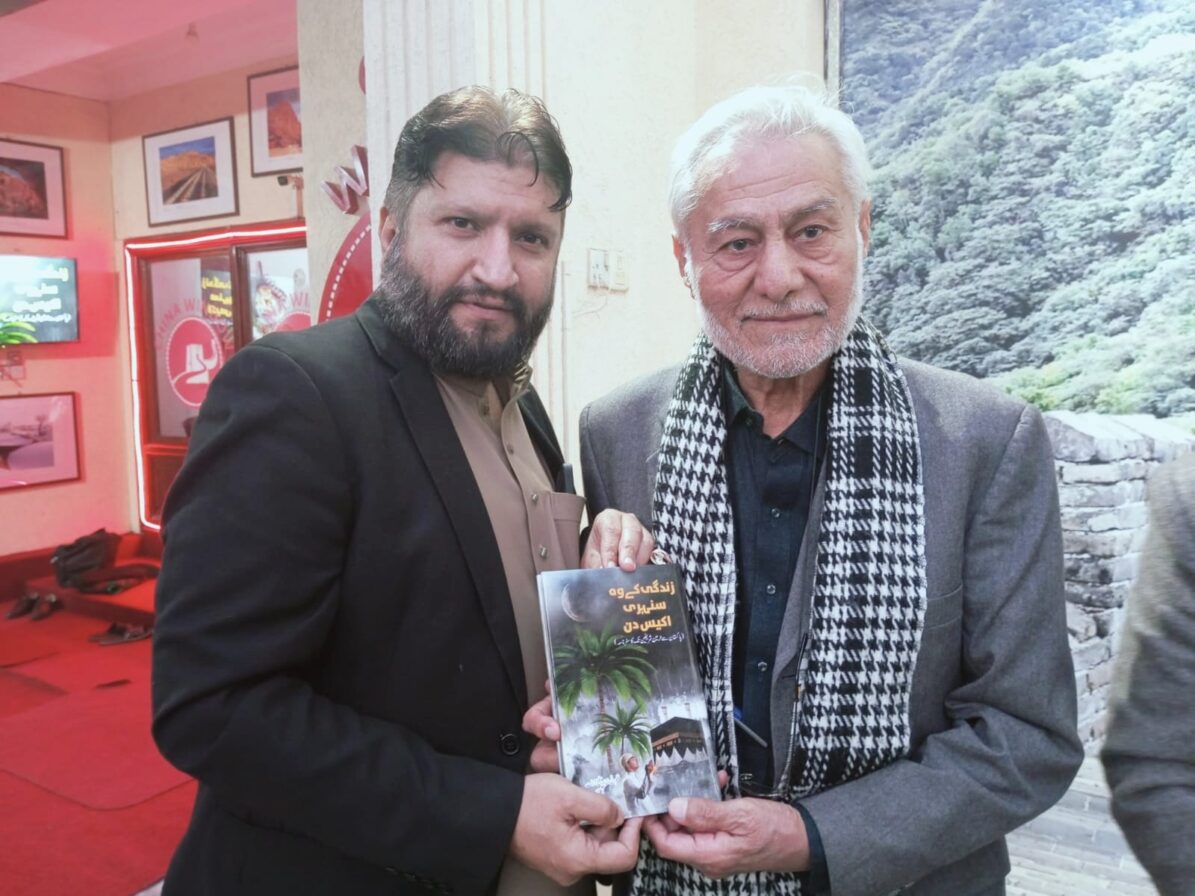
Aman, the founding actor of Pashto cinema, is not merely an artist; he represents an era, a tradition, and a continuum of thought. He not only gave Pashto cinema its identity through his acting but, with the passage of time, has also carried the voice of his inner self to readers through his pen. After his first book, “Main Ek Flop Hero—Lekin” (I Am a Flop Hero—But), his second book, “Zindagi Kay Woh Sunahray Ikis Din” (The Golden Twenty-One Days of Life), is a chronicle of a sacred journey of Umrah—one that is not just a collection of events, but a complete narrative of emotions, states of being, and inner transformation.
This book does not adopt the tone of a formal religious text. Rather, it presents a journey seen through the eyes of a sensitive soul, where every moment leaves a lasting impression on the heart. The most distinctive quality of Aman’s writing is that the reader does not remain a mere observer but becomes a companion on this spiritual journey. The streets of Makkah, the vastness of the Haram, the first sight of the Holy Kaaba, the circling in Tawaf, the brisk walk of Sa’i, and the radiant atmosphere of Madinah—everything is described with such simplicity and sincerity that devotion and reverence shine through every word.
As one turns the pages, it feels as if the reader is himself clad in Ihram, moving among the sea of devoted pilgrims. The honesty with which Aman narrates his inner states transforms the book from a simple travelogue into a spiritual dialogue. At places, there are tears in the eyes; elsewhere, waves of inner peace; at times, a deep accountability of one’s past life; and at others, promises made to oneself for the future.
The literary and intellectual significance of the book was also acknowledged at its launch ceremony held at China Window, Peshawar. On this occasion, Secretary Information Khyber Pakhtunkhwa, Dr. Bakhtiar Khan, said that Khyber Pakhtunkhwa has produced distinguished actors in every era who not only brought honor to Pakistan at home but also projected a positive image abroad. He remarked that writing memoirs and books on intellectual themes after a career in acting is a commendable and exemplary practice.
Dr. Bakhtiar Khan emphasized that Aman has beautifully described the rituals of Umrah as well as the sacred sites of Makkah and Madinah, which makes the book not only literary but also informative in nature. He congratulated Aman on the publication of the book and expressed hope that it would attain a prominent place in the literary world.
The ceremony was attended by former actor Jameel Babar, renowned poet and author Bushra Farrukh, Kulsoom Zaib, actress Shazma Haleem, eminent researcher Haji Aslam Khan, Professor Abaseen Yousafzai, Zulfiqar Qureshi, and other personalities from various walks of life. Senior actor Jameel Babar, while sharing his views, said that Aman has presented his journey to the Holy Shrines as a profound spiritual experience, and that intellectual maturity is clearly evident in the book.
Professor Abaseen Yousafzai described the book as a significant achievement in the literary field, stating that the publication of a second book after acting is proof of Aman’s intellectual breadth. Bushra Farrukh remarked that there comes a moment in every person’s life that leads them to a new path, and it was precisely such a moment that inspired Aman to write this travelogue.
Addressing the ceremony, the author and actor Aman said that performing Umrah was both a spiritual trial and a blessing for him. He added that he put his experiences into book form so that readers could not only learn about the rituals of Umrah but also feel the spiritual atmosphere of the sacred places. He rejected the notion that actors are distant from religion or spirituality, stating that artists, too, are sensitive human beings who value the worship of Allah and the service of His creation.
“The Golden Twenty-One Days of Life” is, in essence, a journey into the inner self of an artist—where fame, identity, and the glare of the screen are left behind, and a human being stands before his Creator simply as a servant. Written in a simple, fluent, and natural style, the book invites readers to self-reflection—without sermons, without commands.
Undoubtedly, Aman’s work is a welcome addition to Urdu literature and spiritual travel writing—a piece that is not merely read, but deeply felt.









Leave a Reply