

BY:BEENA KHAN
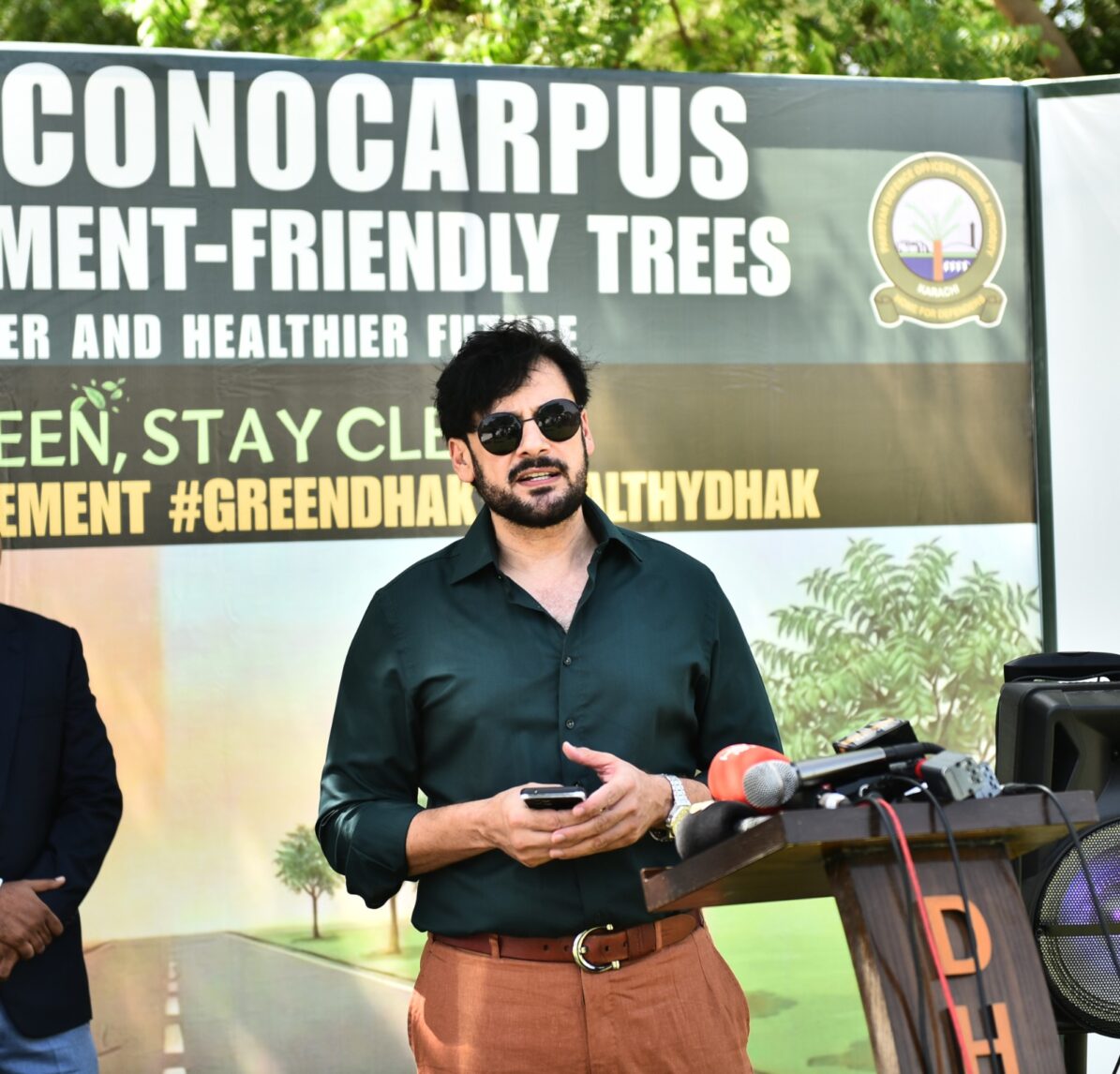
KARACHI: DHA Karachi has undertaken a task to replace Conocarpus trees with local trees. The initiative marks a shift toward more sustainable urban plantation practices in the city.
For years, Karachi’s roads, parks, and green belts have been lined with a fast-growing imported tree known as Conocarpus. Introduced during various plantation drives, over 2.2 million Conocarpus trees were planted across the city, quickly spreading because they grow rapidly and appear hardy in urban conditions.
However, scientists, environmental activists, and policymakers are increasingly warning that the widespread planting of Conocarpus may have been a mistake — one that Karachi must now correct.
Conocarpus is not native to Pakistan. Environmental experts argue that introducing a foreign species on such a large scale can disrupt local ecosystems and reduce biodiversity.
Conservationist Nadeem Mirbahar has repeatedly raised concerns about the ecological impact of the tree.
“Conocarpus does not support local biodiversity,” he has said in discussions on urban forestry. “Birds rarely nest in it, and it does not attract insects or pollinators the way indigenous trees do.”
Botanists and urban forestry specialists say that native trees such as neem (Azadirachta indica), banyan (Ficus benghalensis), and peepal (Ficus religiosa) play a much more important role in sustaining birds, bees, and other wildlife that are part of Karachi’s natural ecosystem.
Another major concern is the tree’s aggressive root system. Environmental researchers warn that Conocarpus roots grow extremely deep — sometimes reaching 100–200 feet underground — and spread widely in search of water. Due to their depth and strength, the roots can penetrate and disturb water pipelines, sewerage lines, drainage systems, and other essential infrastructure, creating long-term maintenance problems in urban areas.
Plantation specialist Shehzad Sadiq, who has worked on environmental conservation initiatives, has cautioned about the tree’s impact on urban services.
“The roots of Conocarpus can penetrate very deep underground and may interfere with sewerage lines, water pipelines, and other infrastructure,” he noted while discussing the environmental risks of large-scale plantation of the species.
Karachi already faces a serious water crisis, and experts warn that Conocarpus can worsen the situation. The tree is known to consume significant amounts of groundwater, which is problematic in an arid coastal city where water resources are limited.
Botanical researchers have also pointed out that pollen produced by the tree may trigger allergies in some residents, particularly during flowering seasons when pollen levels increase in the air. Urban planners therefore argue that planting large numbers of a single exotic species in a dense city environment can create unintended environmental and health problems.
Concerns about the tree eventually reached government authorities. In 2016, the Karachi commissioner announced a ban on the sale and plantation of Conocarpus plants in the city, describing them as environmentally unsuitable and warning that continued plantation could create ecological and public health challenges for Karachi.
Experts say the solution lies not in abandoning urban plantation drives, but in choosing the right trees. Indigenous species such as neem (Azadirachta indica), banyan (Ficus benghalensis), peepal (Ficus religiosa), amaltas (Cassia fistula), gulmohar (Delonix regia), kikar (Vachellia nilotica), beri (Ziziphus mauritiana), and drumstick tree (Moringa oleifera) are far better suited to Karachi’s climate. These trees provide wider shade, require less water, and support a variety of birds and insects, while also helping cool the city during intense summer months.


Many residents have also begun questioning the dominance of Conocarpus in their neighbourhoods.
“I grew up seeing neem and banyan trees across Karachi,” says Ahmed Raza, a retired teacher living in Clifton.
“Those trees provided real shade, and birds nested in them. Conocarpus may grow quickly, but it does not bring the same life to our streets.”
University student Sadia Khan, who lives in DHA, believes public awareness is growing.
“Planting trees is important, but we also need to plant the right species. Indigenous trees make the city greener in a meaningful way.”
Naushaba Khalil, Chairperson of the Horticulture Society of Pakistan, appreciated DHA Karachi’s initiative.
“It’s a very positive step because even though the Conocarpus provide shade, their roots run too deep, and in a city already struggling with water issues, they do not let plants grow, so replacing them is a great initiative,” she said.
Renowned TV personality and environmentalist Tipu Sharif echoed similar sentiments.
“Karachi needs its local plants, and DHA has undertaken a great initiative,” he said.
In view of the negative effects of Conocarpus trees, DHA Karachi has undertaken a four-month transition to gradually uproot Conocarpus trees and replace them with indigenous species better suited to the local environment. Alongside this effort, DHA is also raising awareness among residents about the importance of planting native trees in green belts and residential spaces.
Environmental observers consider this initiative a step in the right direction. With climate change becoming an increasingly harsh reality and temperatures rising every year, the need for environmentally sustainable urban planning has never been greater. In a densely built and rapidly expanding concrete city like Karachi, properly planned green belts and shade-providing indigenous trees are essential for reducing heat and improving environmental conditions.
While DHA Karachi is doing its bit to create better green spaces, environmental experts say the responsibility does not end there. Private companies, developers, and other stakeholders must also take cue from such initiatives and actively encourage the replacement of Conocarpus with indigenous trees in their own developments and projects.
Ultimately, the responsibility also lies with individuals. Residents can contribute by choosing native trees for their homes and neighbourhoods and by supporting initiatives that promote environmentally responsible plantation.
As Karachi faces growing environmental pressures, experts say the future of the city’s urban forests depends not only on planting more trees but on planting the right ones. With responsible institutional initiatives and greater public awareness, Karachi can move toward a greener and more sustainable future.












Leave a Reply