

How Mushroom Farming Is Strengthening Food Security and Women’s Livelihoods in Peshawar
In the suburban communities of Peshawar, where land and income opportunities are limited, a simple innovation is quietly transforming lives. Through SABAWON’s mushroom farming initiative, families are turning small indoor spaces into productive units that provide both nutritious food and a new source of income. The intervention offers a practical response to food insecurity, limited livelihoods, and rising climate pressures—especially for women and landless households.
A Science Backed Community Intervention
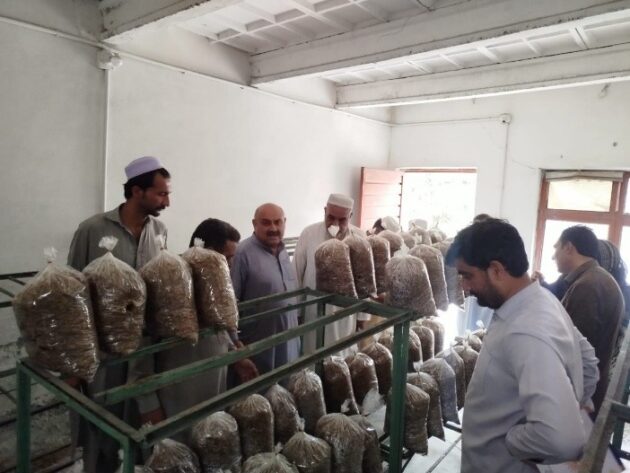
Implemented in collaboration with the University of Agriculture Peshawar and with technical support from the Nuclear Institute for Food and Agriculture (NIFA), the project introduced oyster mushroom cultivation as a climate smart and nutrition sensitive livelihood option. Farmers received hands on training covering the full production cycle, followed by regular follow up visits to ensure successful adoption. Using locally available agricultural waste such as wheat straw, participants established mushroom units inside homes, basements, and shaded rooms, requiring very little space, water, or investment.
From Training to Tangible Results
Within weeks of training, farmers moved from experimentation to production. Initial challenges, particularly around humidity management, were addressed through continued technical guidance during field visits. As a result, most farms reached full fruiting stages, with individual harvests ranging from 2 to 25 kilograms per cycle. Some participants sold up to 20 kilograms per batch in local markets, while others reinvested in repeated production cycles to ensure steady household income.
Women at the Center of Change
Women have emerged at the heart of this transformation. The home based nature of mushroom farming allowed women to manage production independently while balancing household responsibilities. Beyond income generation, the initiative strengthened skills, confidence, and decision making power within families. Regular consumption of mushrooms also improved household nutrition by providing an affordable and locally produced source of high quality protein.
Building Sustainable Livelihoods
By combining income generation, improved nutrition, and efficient use of space and resources, the mushroom farming initiative demonstrates how small scale, science based solutions can deliver lasting impact. What began as a modest training effort is now laying the groundwork for a local mushroom value chain and offering a scalable model for resilient and inclusive livelihoods in Khyber Pakhtunkhwa.
SABAWON Initiative
Home Grown Mushrooms: Low Cost, High Nutrition, Sustainable Livelihoods
 Fig. 5: Pear Oyster
 Fig. 6: Blue Oyster Mushroom
 Fig. 7: Phoenix Oyster Mushroom
 Fig. 8: Golden Oyster Mushroom









Leave a Reply