

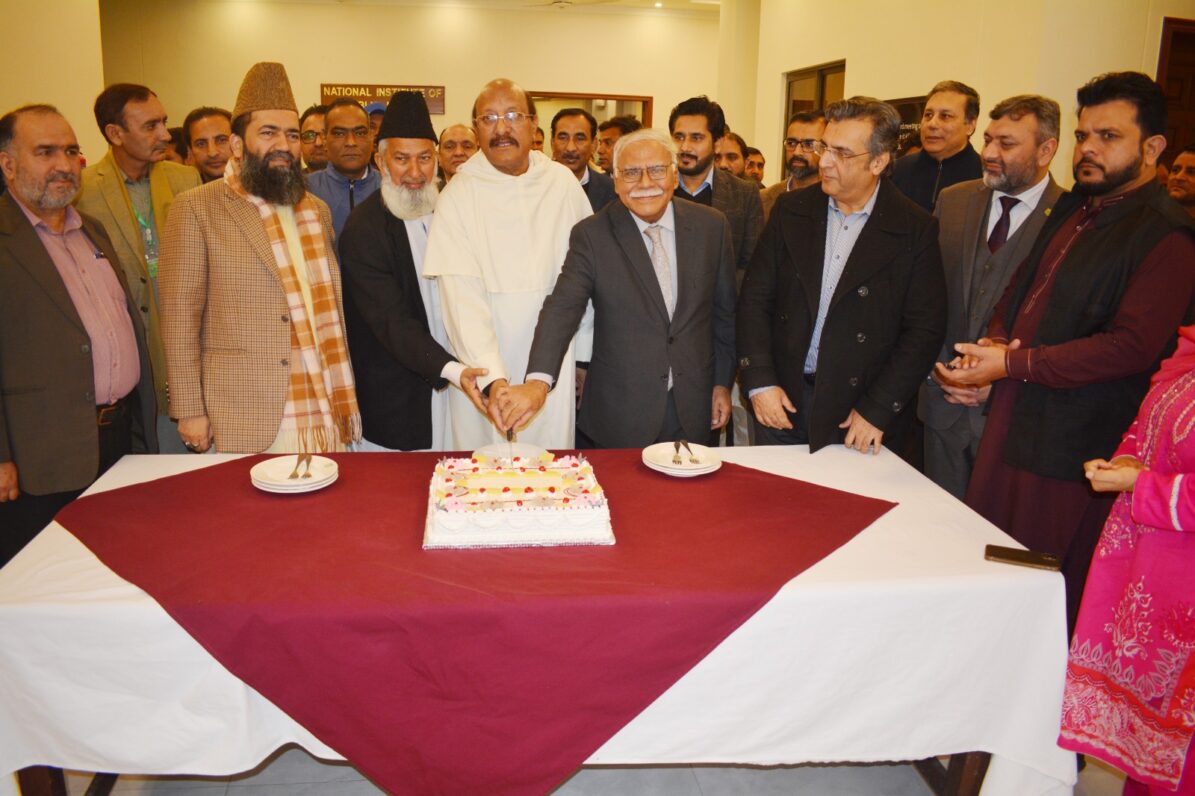
LAHORE – The National Institute of Public Policy (NIPP) hosted a seminar to promote Interfaith Harmony. The event was attended by Maulana Abdul Khabeer Azad, Chairman of the Ruet-e-Hilal Committee, Khateeb of the Badshahi Mosque, Father James Channan, Lahore, Dr. Muhammad Jamil Afaqi, Rector, National School of Public Policy (NSPP) , NIPP leadership and team. Dr. Naveed Elahi, Dean (NIPP) specially invited employees of NIPP belonging from the minority religious communities.
The ceremony started with the recitation from the Holy Quran followed by a reading from the Holy Bible symbolizing the institution’s deep rooted commitment to mutual respect and co-existence.
Dr. Naveed Elahi, Dean (NIPP) opened the proceedings by quoting the historic words of Quaid-e-Azam Muhammad Ali Jinnah:
“You are free; you are free to go to your temples, you are free to go to your mosques, or to any other place of worship in this State of Pakistan. You may belong to any religion, caste or creed — that has nothing to do with the business of the state.”
Dr. Elahi emphasized that these words are not merely a message from the past but a shield of protection and promise to all religious communities residing in Pakistan.
Father James Channan addressed the audience, stating that Pakistan’s diversity is its strength and that interfaith harmony is the ultimate key to the country’s success. He noted that Pakistan’s narrative of inclusion of these rules are now globally recognized by the United Nations, Saudi Arabia, Jordan and the Vatican largely due to the wide circulation of the Paigham-e-Pakistan program.
Maulana Abdul Khabeer Azad, emphasized that maintaining communal harmony is a religious and moral obligation. He highlighted that unity among all religions is the prime agenda of the State of Pakistan and the message of Islam as well. He further added that the Paigham-e-Pakistan initiative has successfully conveyed the state’s message of peace both domestically and internationally.
In closing remarks, Dr. Muhammad Jamil Afaqi, Rector (NSPP) stressed that while the state is responsible for policy and rule of law, the actual practice of harmony belongs to the people. He noted that interfaith harmony must be a collective effort of all citizens rather than just a state policy.





Leave a Reply