

By Latif Ur Rehman
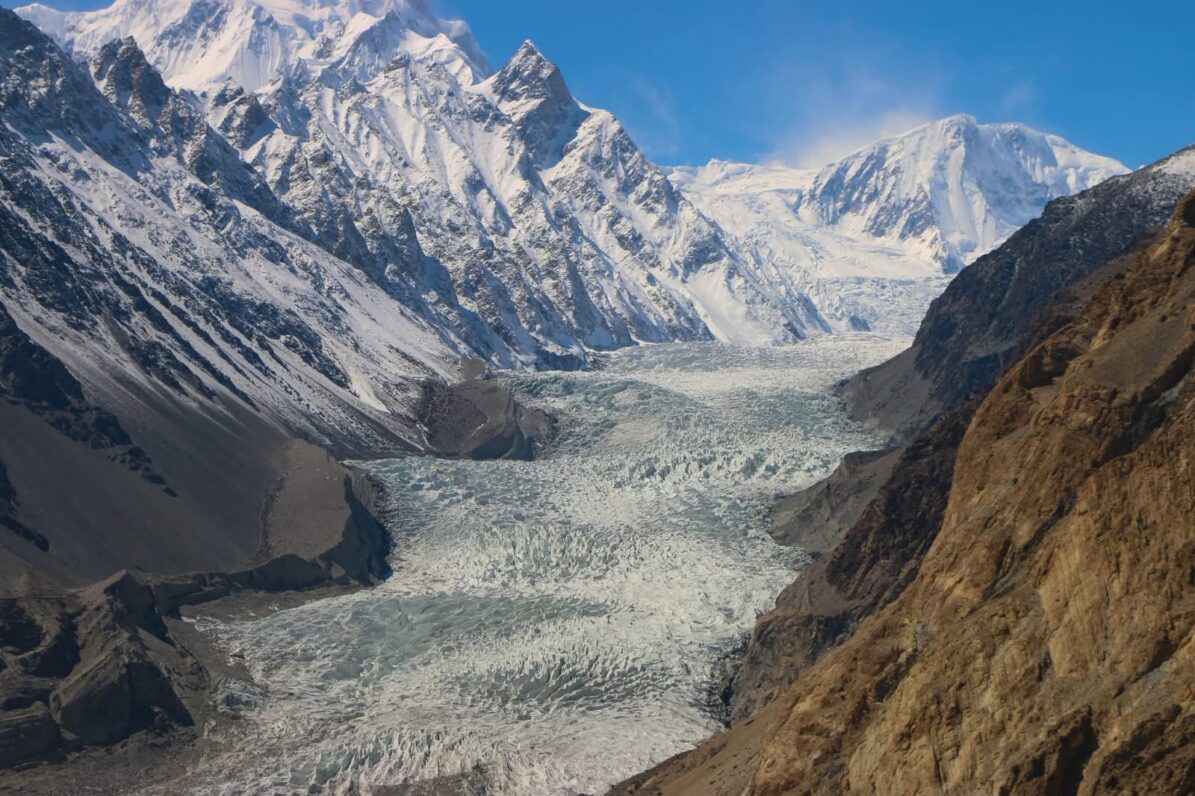
In the high altitudes of northern Pakistan — where the sky seems within reach and silence carries the weight of centuries — glaciers rest like ancient sentinels. Draped across the mighty ranges of the Karakoram, Himalayas, and Hindu Kush, these colossal bodies of ice are more than geological marvels; they are the lifeblood of a nation. They breathe water into the veins of the Indus River system, sustain ecosystems of rare beauty, and quietly uphold the survival of millions downstream. Yet today, these frozen frontiers stand at a precarious crossroads —threatened by a warming climate, human pressures, and an uncertain future.
Pakistan, often described as home to the “Third Pole,” holds one of the largest reserves of glaciers outside the polar regions. These glaciers are not merely static formations; they are dynamic, living systems that regulate water flow, shape landscapes, and anchor biodiversity. From the towering K2 to the formidable Nanga Parbat, the country’s mountainous north is a realm where ice, rock, and life coexist in delicate balance. But this balance is increasingly under siege.
Climate change has emerged as the most formidable adversary of these icy giants. Rising temperatures, erratic precipitation patterns, and accelerating glacial melt are rewriting the hydrological narrative of Pakistan. Scientific observations reveal a troubling trend: glaciers, particularly in the Himalayas and Hindu Kush, are retreating at alarming rates, while meltwater runoff is intensifying. This paradox—of abundance followed by scarcity—poses one of the greatest challenges to Pakistan’s water security.
In the short term, increased glacial melt feeds rivers with greater intensity, often resulting in devastating floods, landslides, and glacial lake outburst floods (GLOFs). These sudden and violent events leave behind trails of destruction—sweeping away homes, livelihoods, and infrastructure. In the long term, however, the story darkens further. As glaciers shrink, the very source of freshwater begins to dwindle, threatening agriculture, energy production, and human survival.
The Indus River, nourished significantly by glacial and snowmelt, supports one of the largest irrigation systems in the world. Nearly half of its annual flow originates from these frozen reservoirs. For a country where agriculture forms the backbone of the economy, any disruption in water supply reverberates across sectors—food security, livelihoods, and economic stability all hang in the balance.
Yet the crisis is not confined to water alone. The ecological implications are equally profound. Glacial ecosystems are sanctuaries for rare and endangered species—the elusive snow leopard, the majestic markhor, and countless other forms of life that depend on fragile alpine habitats. As glaciers retreat, these ecosystems face fragmentation and degradation, pushing biodiversity toward the brink.
Amid this unfolding crisis, mountain communities find themselves on the frontlines. Living in close proximity to glaciers, these communities have long maintained a harmonious relationship with nature. Their lives are intricately woven with the rhythms of ice and water. But today, they bear the brunt of climate-induced disasters. Flash floods, landslides, and GLOFs strike with little warning, disproportionately affecting women, children, and marginalized groups. The loss of livestock, crops, and homes inflicts wounds that linger across generations.
Adding another layer of complexity is the phenomenon known as the “Karakoram Anomaly.” Unlike many glaciers worldwide that are retreating, some glaciers in the Karakoram range exhibit relative stability—or even slight advancement. This anomaly has intrigued scientists, highlighting the intricate interplay of local climate conditions, debris cover, and glacial dynamics. Yet, it does not negate the broader reality of climate change; rather, it underscores the need for deeper research and nuanced understanding.
Pakistan’s response to this multifaceted challenge has evolved through a combination of policy frameworks, institutional mechanisms, and international collaborations. The National Climate Change Policy, the National Adaptation Plan, and the Nationally Determined Contributions under the Paris Agreement collectively provide a roadmap for resilience. These frameworks recognize glaciers as critical natural assets and emphasize the need for their protection.
At the institutional level, organizations such as the Ministry of Climate Change, NDMA, WAPDA, SUPARCO, and the Pakistan Meteorological Department are actively engaged in monitoring, research, and disaster risk reduction. The establishment of glacier monitoring networks, early warning systems, and hydrological models marks a significant step toward informed decision-making.
International partnerships further strengthen these efforts. Collaborations with UNDP, ICIMOD, EvK2CNR, and other global entities have facilitated glacier inventories, risk assessments, and community-based adaptation initiatives. Projects like GLOF-I and GLOF-II have enhanced early warning systems and built resilience in vulnerable regions, while innovative programs such as “Glaciers and Students” have fostered scientific engagement and awareness.
Despite these advancements, challenges persist. Data gaps, limited coordination, and resource constraints hinder the effective implementation of policies. Moreover, the transboundary nature of the Hindu Kush-Karakoram-Himalaya region calls for regional cooperation—an area that requires sustained diplomatic and scientific engagement.
Globally, countries facing similar challenges have adopted innovative approaches to glacier protection. From reflective blankets in Austria to artificial ice stupas in the Himalayas, these practices offer valuable lessons. While not all solutions are directly transferable, they highlight the importance of creativity, technology, and community participation in addressing climate challenges.
In Pakistan, the path forward lies in a holistic and integrated approach. Monitoring and research must be expanded through advanced technologies such as remote sensing, drones, and geographic information systems. Early warning systems need to be scaled up to provide timely alerts for GLOFs and other hazards. Sustainable water management practices must ensure efficient use of glacial meltwater, balancing immediate needs with long-term sustainability.
Equally important is the role of communities. Empowering local populations through education, capacity building, and livelihood diversification can transform them from vulnerable victims into active agents of resilience. Traditional knowledge, often overlooked, holds valuable insights into sustainable resource management and adaptation strategies.
Ecosystem protection is another critical pillar. Preserving high-altitude watersheds, curbing deforestation, and promoting biodiversity conservation are essential for maintaining ecological balance. Protected areas and conservation corridors can safeguard habitats while supporting sustainable tourism—a sector that, if managed responsibly, can provide economic opportunities without compromising environmental integrity.
The narrative of Pakistan’s glaciers is not merely a story of ice and climate; it is a story of interconnectedness. It is about how distant mountain peaks influence fertile plains, how melting ice shapes human destinies, and how the choices of today determine the realities of tomorrow.
As the world grapples with the broader challenge of climate change, Pakistan’s glaciers stand as both a warning and a call to action. They remind us that the consequences of inaction are not distant abstractions but immediate realities. They urge us to rethink our relationship with nature—to move from exploitation to stewardship, from indifference to responsibility.
In the end, the fate of these glaciers is intertwined with the fate of millions. Protecting them is not merely an environmental imperative; it is a moral obligation. It is about safeguarding water, preserving biodiversity, and ensuring that future generations inherit a world where rivers still flow, ecosystems still thrive, and the silent guardians of the mountains continue their timeless watch.
The challenge is immense, but so is the opportunity. With science, policy, and community working in harmony, Pakistan can chart a path toward resilience—where glaciers are not symbols of loss, but pillars of hope in a warming world.
—
Author: Latif Ur Rehman, is a Spokesperson at Department of Climate Change, Forestry, Environment & Wildlife,
Khyber Pakhtunkhwa – Pakistan.
He may be contacted at his email: latifmedia@gmail.com











Leave a Reply