

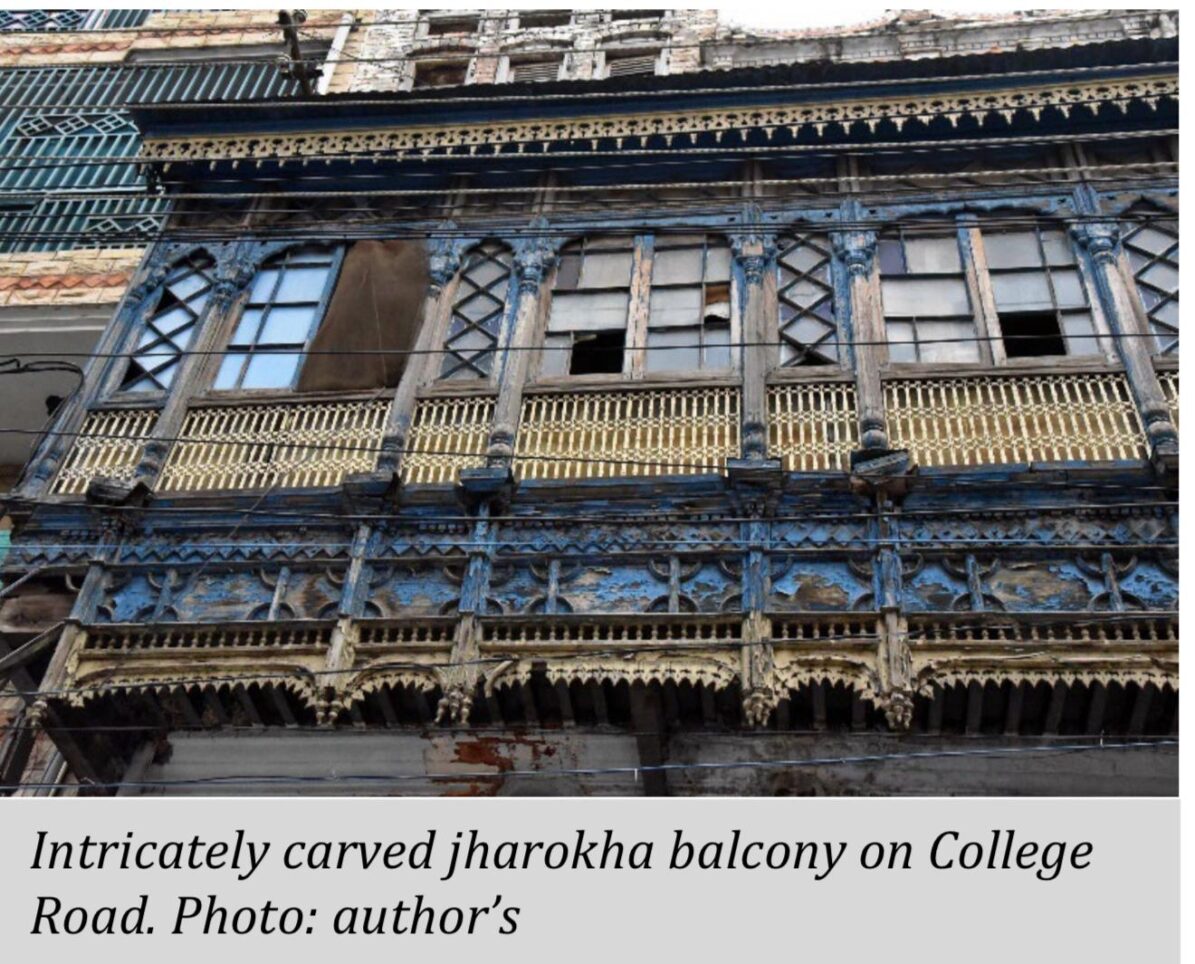
A personal appeal to protect, restore and present one of Pakistan’s most accessible historic urban quarters By Virginija Morgan-Hayat Less than half an hour’s drive from the federal capital, beyond the rush of traffic and the familiar disorder of busy bazaars, lies a treasure that, if utilized, can become a hub of local and international tourism and economic activity at par with some of the best tourism centers in the region. One must have figured out I am talking about Taxila – or perhaps Said Pur village? I believe that neither of these sites, while valuable in their own right, can compete with the real gem, the historic center of Rawalpindi, which offers a compilation of various religious, residential and commercial buildings unique to south Asia’s complex historic past. Moreover, it is also a bustling maize of traditional bazaars, offering a glimpse of traditional lifestyle long gone from the more modernized and polished Western world. To a hurried passer-by, old Rawalpindi may appear congested, chaotic and decaying. Yet beneath the tangles of electric cables and neglect, lie the beautifully detailed facades of once wealthiest havelis, with intricately carved doors, delicate metal corbels carrying jharokha-style balconies, half-domed window frames, intertwined with the towering domes of temples, shrines, and mosques. It is not the carefully curated Pakistan that visitors are usually shown in Lahore, Islamabad or Taxila. It is something more intimate and, to my eye, more powerful: a living city, carrying its history in plain sight. For the past 15 years, I have visited the historic center of Rawalpindi dozens of times, camera in hand, searching for lanes that still retain their old grace and worrying each time that another beautiful building may have disappeared behind a concrete replacement. As a foreigner who has spent many years in Pakistan, I have often felt that the country underestimates what it possesses. Rawalpindi’s historic centre is one of those overlooked treasures. To a photographer, it is a layered urban archive.

the craftsmanship of a vanished era. A fading doorway may tell the story of a merchant family. A temple dome rising above a bazaar may speak of a community that left at Partition but whose imprint remains. A mosque, shrine or imambargah still in active use reminds us that this is not a museum city. It is a living one.

That living quality is precisely what makes Rawalpindi valuable. Around Bhabra Bazaar, Sarafa Bazaar, Purana Qila, Jamia Masjid Road, Bohar Bazaar, Raja Bazaar and the lanes around Shah Chan Charagh, one still finds the signs of Muslim, Sikh, Hindu, Jain and Parsi communities that traded, built, worshipped, studied and raised families in the same dense urban fabric. Their world was transformed forever in 1947, but its physical memory has not vanished. It survives in havelis, mosques, temples, gurdwaras, schools, graveyards, bazaars and the street pattern itself. Pakistan has extraordinary heritage, but much of it is either monumental, archaeological or distant from the everyday routes of most citizens. Rawalpindi is different. Its historic core lies beside Islamabad, minutes from the federal capital, yet many visitors to Islamabad — and even many residents of Rawalpindi — barely know that this older world exists. That proximity is a strategic advantage. Properly protected, restored and interpreted, Rawalpindi’s old city could become one of Pakistan’s most accessible heritage experiences. School groups, university students, families, domestic tourists, diplomats, diaspora visitors, photographers, historians and official guests could experience it without long travel. It could become a place where Pakistan presents not only its monuments, but its urban memory. And what a memory it is. The historic centre of Rawalpindi tells a story of trade, faith, coexistence, migration and resilience. It tells of Jain and Hindu merchant families, Sikh havelis, Muslim shrines, old bazaars, educational institutions, colonial transitions, Partition, refugee resettlement and Pakistan’s early decades, when Rawalpindi briefly served as the country’s interim capital while Islamabad was being developed. Few cities in Pakistan offer such a concentrated story within such a compact and accessible area. Yet this inheritance is in danger. Many old buildings are deteriorating. Upper floors are abandoned or poorly maintained. Facades are hidden behind signage and tangled wiring. Historic structures are altered without regard for their original character. Some landmarks are difficult to identify, access or interpret. The street pattern survives, but without a serious conservation and tourism plan, the old city will continue to lose its character piece by piece.

The loss would not only be cultural. It would also be economic. Across the world, living historic quarters have been turned into engines of tourism, small business, employment and civic pride. Marrakech and Fez in Morocco, Bukhara and Khiva in Uzbekistan, and Icherisheher in Baku show how old cities can thrive when governments protect their fabric, improve public spaces, regulate visual clutter, support adaptive reuse and help visitors understand what they are seeing. Rawalpindi should not copy these cities, and it should certainly not be sterilised into an artificial tourist zone. Its strength lies in the fact that it is still alive. The shops, food stalls, religious sites, homes, workshops and bazaar rhythms are part of its authenticity. The challenge is not to empty the old city of life, but to make that life more visible, more dignified and more economically productive. A restored Haveli Sujan Singh could become the natural anchor of this effort: a city heritage centre, exhibition venue, reception point and starting place for guided walks. From there, carefully designed routes could connect visitors to Bhabra Bazaar, Jamia Masjid, Shah Chan Charagh, Sarafa Bazaar, old havelis, Jain and Sikh heritage sites, temples, imambargahs, Bohar Bazaar, College Road, Kalyan Das Temple, the Parsi Graveyard and the wider old-city landscape. Such a programme would not be an exercise in nostalgia. It would create work for guides, artisans, conservation workers, shopkeepers, food vendors, photographers, designers, event managers and small entrepreneurs. It would give schools and universities a living classroom. It would encourage families from Islamabad and Rawalpindi to see the old city not as a congested commercial maze, but as a place of memory and pride. It would allow Pakistan to show visiting officials and foreign guests a different face of the country: not only strategic geography or political headlines, but cultural depth, resilience and plural history. For Punjab, this is a rare opportunity because the province does not need to build a destination from scratch. Rawalpindi already has the streets, buildings, stories and location. What it needs is recognition, protection and careful management. The Government of Punjab could begin by declaring a protected historic core, preparing a proper inventory, restoring key buildings, improving signage and wiring, managing traffic and loading, and developing a phased heritage-tourism plan. This work must be professional, but it cannot be imposed from above in a way that ignores the people who live and work there. Traders, residents, religious custodians, historians, architects, photographers, teachers and young people should be part of the process. If the old city is to be saved, those who carry its daily life must see themselves as partners in its future, not obstacles to it.

In time, Rawalpindi could also be placed on a serious pathway toward UNESCO consideration. It is not ready for nomination today, and it would be misleading to suggest otherwise. Such processes require documentation, protection, management and discipline. But the old city has the ingredients of a strong future candidate: a living bazaar city, multi-faith mercantile heritage, architectural layering, historic continuity and an extraordinary location beside the national capital. For me, this argument is not abstract. I have spent years looking at Pakistan through the lens of a camera. Again and again, I have found beauty in places that are not polished, not easy and not yet presented as destinations. Rawalpindi’s old city has that quality. It has soul, and soul is something no amount of new construction can manufacture. Once lost, this urban memory cannot be rebuilt. A replica balcony, a newly painted facade or a themed market can never replace the accumulated texture of a city that has lived through centuries of trade, migration, faith and change. Punjab now has a chance to save one of its most accessible historic urban quarters — not by freezing Rawalpindi in the past, but by allowing its past to become part of its future. The old city can be a heritage district, a tourism hub, a source of employment, a place of interfaith historical understanding and a point of pride for Pakistan. Rawalpindi does not need to be rediscovered. It is already there, waiting in plain sight. It needs to be protected, restored and allowed to speak. About the author: Virginija Morgan-Hayat is a traveler, photographer and retired public communications professional who spent a decade living and working in Pakistan for USAID and other international and local organisations. She currently resides in Azerbaijan with her husband, a former Pakistani government officer and senior UN diplomat.


Leave a Reply