

Anees Takar
PESHAWAR: Before dawn breaks over Garhi Saidan, Qadar Badshah is already at work. By five in the morning, he has completed milking his animals, collecting a few liters for immediate sale while setting aside the rest in metal containers. For years, this routine carried an unspoken anxiety. The journey to the market—under a rising sun and without refrigeration—meant that a portion of his milk would inevitably spoil, or be sold at a fraction of its value.
“Earlier, I had no choice,” he reflects. “Either sell at a low price or lose the milk entirely. Now, nothing goes to waste.”
Qadar’s experience reflects a long-standing structural challenge within Pakistan’s dairy sector. Despite being one of the country’s most significant contributors to the economy—accounting for 56.3 percent of the agricultural sector and approximately 11 percent of the national GDP—the industry has struggled with inefficiencies at the smallholder level. For millions of rural households, livestock is a primary source of income, yet the absence of cold storage facilities has historically undermined both productivity and profitability.
Milk, by its very nature, is highly perishable. In sub-urban and rural contexts, where access to electricity is unreliable and cooling infrastructure is scarce, the window between production and spoilage is often just a matter of hours. This forces farmers into unfavorable market dynamics, where middlemen exploit the urgency to sell by offering reduced prices. The result is a cycle of constrained earnings and persistent vulnerability.
Across different communities, the scale of this issue has been strikingly consistent. In Wahid Garhi, Mukarram Khan, a small-scale farmer with a single cow, routinely lost between five to ten percent of his daily milk production. In Kochian, Riaz Khan reported losses ranging from eight to fifteen percent, while in Khazana Payan, Willayat—managing a slightly larger herd—faced spoilage rates of up to 25 percent. Even within farmer clusters producing larger volumes, such as the group led by M. Humayun, daily losses of six to fifteen percent were common.
These figures are more than statistics; they represent lost income, wasted labor, and missed opportunities in communities where margins are already thin.
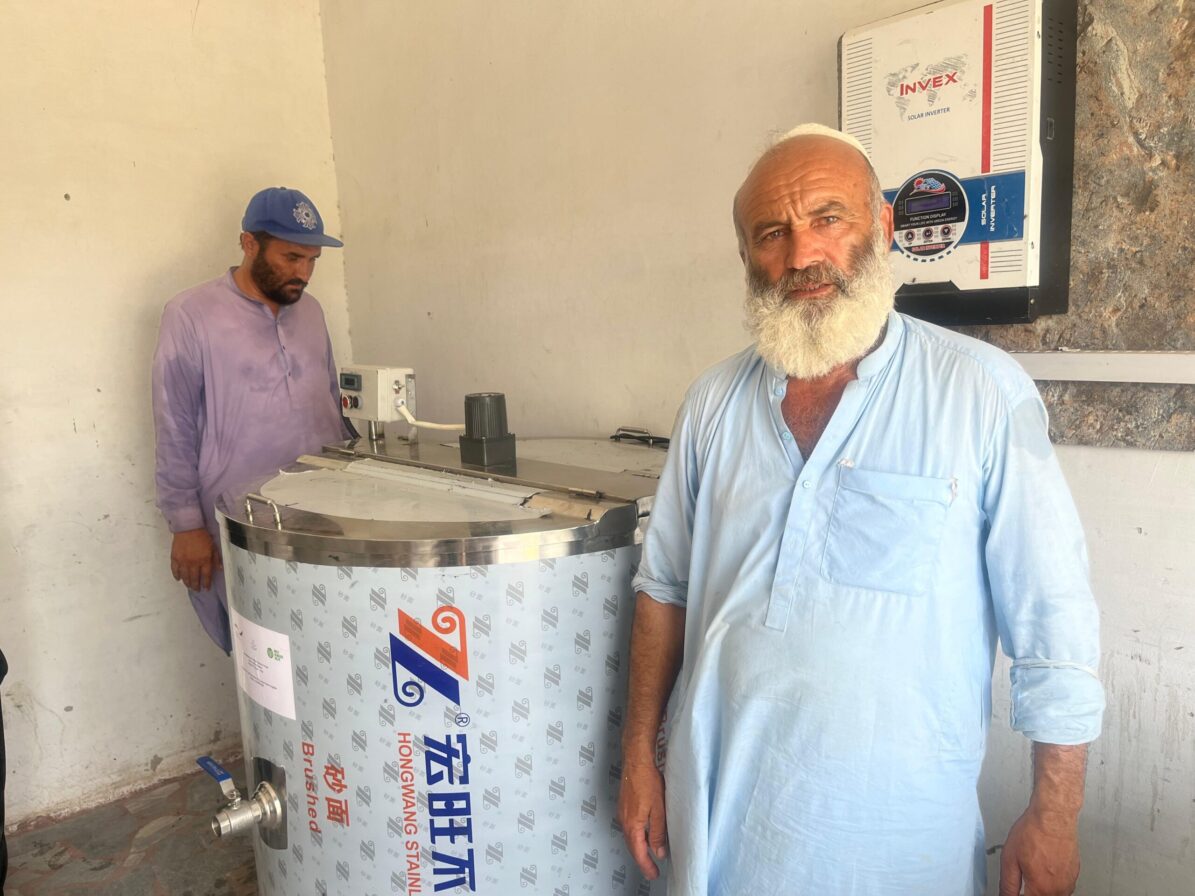
It is within this context that SABAWON, an organization dedicated to strengthening agricultural value chains, introduced a targeted intervention aimed at addressing the root of the problem: the lack of accessible cooling systems. Recognizing that individual ownership of milk chillers would be financially unviable for smallholders, the organization adopted a cluster-based model. Shared, solar-powered bulk milk chillers were installed at the community level, allowing multiple farmers to collectively benefit from a single unit.
Dr Owais Akhoonzada Livestock Officer SABAWON, stated that the project has successfully established five milk chiller plants, each managed by a farmers’ group comprising 10 to 15 members. These facilities primarily support small-scale farmers, who bring their surplus milk to the chiller plants for quality testing and preservation. The collected milk is further processed, including conversion into yogurt, ensuring value addition and reducing wastage. He added that this initiative has significantly benefited more than 50 farmers by providing them with better market access, improved income opportunities, and a reliable system for handling excess milk production.
This approach was both pragmatic and strategic. By leveraging solar energy, the chillers bypassed the persistent challenge of electricity outages, ensuring uninterrupted operation. At the same time, the shared model reduced costs while fostering collaboration among farmers.
However, the initiative extended beyond infrastructure. SABAWON placed significant emphasis on capacity building, providing hands-on training to ensure that farmers could independently operate and maintain the equipment. This not only enhanced the sustainability of the intervention but also strengthened local ownership and confidence in the technology.
Equally critical was the effort to improve market linkages. By enabling farmers to supply consistently high-quality, chilled milk, the intervention opened pathways to formal dairy processors and more stable markets. This shift reduced reliance on informal intermediaries and created opportunities for better price realization.
The results have been both measurable and transformative. In a cluster of ten farmers, daily milk spoilage was reduced by approximately 16 to 25 percent. For individuals like Qadar Badshah, the change has translated directly into higher income and greater stability.
“Before the chiller, I sold buffalo milk at 200 rupees per kilogram and cow milk at 180,” he explains. “Now, I get 220 for buffalo milk and 200 for cow milk.”
This increase of roughly 10 to 11 percent in unit prices, combined with the near elimination of spoilage, has significantly enhanced overall earnings. For Mukarram Khan, the benefits extend beyond income. “The quality of my milk has improved,” he notes. “Customers trust it more, and I feel more secure about my work.”
For M. Humayun and his fellow cluster members, who collectively produce around 200 liters per day, the transformation has been equally profound. What was once a system marked by daily losses has evolved into one of efficiency and reliability. “The machine is simple to use,” he says. “And because it runs on solar power, we are no longer affected by load shedding.”
Even smaller producers, such as Riaz Khan, have experienced significant gains. Where he once lost up to 15 percent of his daily yield, he now reports zero spoilage and improved market access. Similarly, Willayat describes the intervention as a turning point, not just economically but psychologically. “It has brought peace of mind,” he says. “I no longer worry about losing my hard work.”
Beyond these individual narratives, the broader implications of this intervention are noteworthy. By addressing a critical bottleneck in the dairy value chain, solar-powered milk chillers have contributed to stabilizing smallholder operations and safeguarding livelihoods. More importantly, they have begun to rebalance market dynamics, empowering farmers to negotiate from a position of strength rather than necessity.
The findings, supported by a combination of qualitative and quantitative research—including interviews, focus group discussions, and market surveys—underscore the importance of context-specific solutions. Successful implementation depends not only on technology but also on community engagement, training, and access to markets.
In this sense, decentralized cooling systems represent more than a technical fix; they are an enabling mechanism for broader socio-economic change. By reducing waste, improving quality, and enhancing market integration, they create a ripple effect that extends beyond individual farmers to entire communities.
As Pakistan continues to navigate the challenges of rural development and food security, such innovations offer a compelling model for scalable impact. They demonstrate how targeted interventions, grounded in local realities, can unlock new opportunities within traditional sectors.
For farmers like Qadar Badshah, the transformation is already tangible. What was once a daily struggle against time and temperature has become a story of resilience, adaptation, and progress.
In the quiet hum of a solar-powered chiller, a new chapter in Pakistan’s dairy economy is being written—one that is cooler, fairer, and far more promising.









Leave a Reply